
Being Authentically You
I was listening to a podcast the other night and it really resonated with me because I’ve struggled for decades to find meaning and my place in the world. There was a specific quote from Oprah that has stuck with me, and she said, “Whatever is holding you back in your own life, whatever is preventing you from being your authentic self, is also keeping you from your truest, greatest power.”
When I look back at the last 17 years of my life (meaning the time I entered the professional workforce after college), what I see is that graduating from college was the point at which I began rejecting my authentic self. Up until that point, I’d followed my heart and did what I wanted to do. I wasn’t worried about bills or the future or choosing a practical field; I wanted to study literature and Spanish—so I did.
After that, as real life hit, I almost always took whatever jobs were available regardless of whether or not I wanted them. I was afraid to change trajectory and afraid to examine what could be, and I was also afraid to walk away from any opportunity to earn the money I needed to pay bills. The result is that the last 17 years have been a complete and total loss of myself despite material advancement and professional success.
The podcast was looking back to 1997, when Ellen Degeneres came out and when I was 16 years old and still being me. It examined how the negative fallout of her telling the truth morphed into something beautiful and impactful, and ultimately became the best version of Ellen’s life that there could be.
I’ve found myself in the same space lately. I’m forcefully rejecting who I’ve pretended to be for so many years (a corporate professional) and instead am seeking to become who I truly am (a writer and a teacher). If you’re out of a job like me, it’s the perfect time to contemplate whether or not what you’re doing is authentically you. Are your life and/or career choices allowing you to not just grow your bank account and skills, but to grow into the greatest version of who you were meant to be?
I said to someone the other day that I’ve been chasing money for a long time. I’m not a materialistic person at all, to be clear; I’m a person who spent her childhood and most of her young adulthood hurting for money. So I live in fear of returning to a feeling of lack. I live in fear of running out of food, of losing my home, of not having even fifty cents to spend on anything extra. So my response to that fear was to use my liberal arts degree as a way to chase increasingly larger paychecks in the absence of a meaningful career path, and therefore avoid finding myself in a bad financial spot.
But what happened was that, while I avoided becoming financially poor (although I did become poor again for a while in 2010), I instead became a different kind of poor. I became poor in spirit, because I was doing jobs that sucked the life out of my soul. I became poor in health, because the stress of my work was taking a daily toll on my body. I became poor in emotional happiness, because the turmoil of doing something that was not “me” was a constant gaslighting on the inside.
I’ve spent years insisting that everything is fine, that I’m making good money, that I should be grateful instead of perpetually discontent. And I’ve also reasoned that life is pretty darn good and that I really have nothing to complain about, so I just need to soldier on because nobody really loves their job anyway.
But lying to myself is pushing the real me down into a black pit. It’s dimming the light inside of me that has always strived to do and to be extraordinary, and instead has caused me to settle for what is instead of striving for what could be.
As I sit at this juncture in my life (as an unemployed person who’s lost yet another corporate job that was antithetical to who I am), I feel like Ellen probably felt in 1997: I can no longer continue living a life that isn’t actually who I am. I have to tell the truth about me. And the truth is the complete opposite of the life I’ve been living.
“Me” is not the managing editor in charge of digital marketing programs to make a corporation money, like I most recently was. “Me” is not the technical writer or the project manager or the marketing consultant, which I’ve been too.
No, “me” is the writer who creates meaningful blog posts like this one and who also has a book coming out about how to get through life. “Me” is the 5th grade teacher that I was back in 2010-2011, who wanted to make a difference in the lives of kids but was dismayed to find it was just too hard.
“Me” is also the Student Body President I was in high school, leading other students in activities such as painting an old man’s house with Habitat for Humanity, or cleaning up garbage along a creek, or tutoring elementary school kids who needed help. “Me” is the lit major focusing on American lit and African American lit before life hit, and having in-depth conversations with professors and students about humanity and all its flaws.
So that’s me.
Now, who are you?
It pains me to admit that the only true-to-me things I’ve done in my post-college career are writing a book, starting this blog, and teaching school. Everything else was a boldfaced lie that I told to myself and to the world so that I could avoid that poverty thing I’m so afraid of. And I suspect this is probably why every single one of my corporate jobs imploded—even the ones that started out with promise. They just weren’t who I wanted or was meant to be. I only did them because of fear, every single time.
Change is hard, but when I look at Ellen and how her life completely transformed after she had the courage to just be who she was, I can’t help but think my life will be the same. All of our lives could be the same if we just had the balls to figure out how to be more truthful about ourselves. Sometimes it’s hard to stand vulnerably in front of the world, waiting to see if you will be accepted or rejected for who you are. But there is no other way to live fully except to be whoever you happen to be.
To discover our true selves, we can start by listening to our guts. I think if you have a nagging feeling that something isn’t right in your life, or if you just can’t seem to be fully content in your days, or if you think you would love to do (or be) something else, then you’re probably living some form of a lie that you know is there. The question is, how long can you continue living it before you just can’t do it anymore?
I turn 40 in November and I’m at a point where I cannot, for one more second, continue to live the lie. I cannot work in places I am morally opposed to. I cannot participate in capitalism when the real me is not a money-making machine. I cannot give so much of my creative and physical energy to jobs such that there is nothing left for myself. And I think if I just follow “me” wherever I go, as long as I really do follow my truth, things will turn out ok. I’ll make it. Life will unfold in a magnificent way.
So I look forward to stepping boldly into my next chapter with naked authenticity. I look forward to finally being myself and experiencing the magic of living a life based in truth. I also look forward to seeing who will accept me and who will reject me, and finally deciding I just don’t care about anyone’s opinions anymore.
How about you?
———
To leave a comment or share this post, scroll down.
My first book, Halfway There: Lessons at Midlife, was released on August 18, 2020 by Warren Publishing and was re-released on February 16, 2021 by White Ocean Press. To read an excerpt, check out reviews, see the author Q&A, or find links to buy, click the Learn More button.

I Know You're Angry
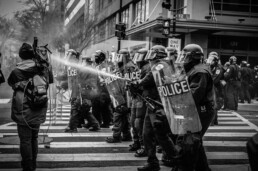
I woke up this morning to a friend messaging me through Instagram about her anxiety around the news and all the civil unrest. It was good timing because today is one of the rare days when my anxiety is mostly under control, so I was able to console her a bit.
As a mostly white (I’m honestly all mixed racially, though) woman who is married to a black man, and as someone who studied African American literature in college, issues of race are really important to me even though they don’t usually affect me very much. I’m not going to get all pedantic about the state of the world and try to lecture people one way or the other, and I’m also not going to go into why I think what’s happening in the streets right now is predictable. But what I will say is that whatever you believe is the correct behavior for the moment, what’s actually happening is that humans are really hurting.
When I went through my divorce many years ago, I passed through a stage where I was so angry that I couldn’t say enough F words to get it out. I was not a person who had ever cussed much, and I certainly never said that word because it felt like the worst of the worst, but an accumulation of negative experiences began to change who I was and how I behaved. I was looking for a valve to release the pressure and that word was the best one I could find.
I’d also started to go through these mini rages at home alone when I’d never been a particularly angry person before. After each storm finally passed through my system, my true emotions would start to take over and my eyes would rain buckets as I realized I was actually deeply hurt. People who are angry are hurt. Remember that. An angry person is someone you could potentially be if your life circumstances had aligned in a certain way.
Most of us can surely recall times when we’ve exploded. We usually explode with words and use them to wound those around us, but sometimes we take a step beyond words into physical action. This may mean we throw something against the wall or punch a hole in it because we recognize that hurling objects (or fists) at humans isn’t a good way to go, and thankfully most of us engage in these escalated explosions sparingly.
When I used to explode particularly badly, my favorite behavior was to use a pillow to beat the arm of the sofa or the footboard of my bed. There was also one time, again during a divorce-era mini rage, when I took a big wine glass and shattered it in the sink so as not to create a huge mess for myself after the explosion was over. At least I had the mental faculties to contain the glass to a small area rather than spewing it across my kitchen.
Even with all of the work I’ve done to be a happier person and to heal myself, I still beat the bed or sofa with a pillow on the rare occasions when lifelong hurts get the best of me. And I wonder if that’s how some people with lifelong hurts are feeling right now? And then I think, what if my own hurt/anger was amped up by centuries of abuse and pain rather than just a few years or decades? I wonder, then, what sort of explosion I might have?
I don’t condone violent behavior. I never do, because I don’t think violence is a good solution to anything and it usually brings about more violence. But I do understand it at this juncture in our history, and I encourage you to try to understand it (understand it, not condone it) instead of judging people for their explosions—especially if you’re a white person like me.
A few days ago, I cried on my husband’s shoulder and hugged his neck, spitting out words in between sobs about how I didn’t want him to be next and how I was afraid he’d get hurt. He reminded me that he’s had to watch his back his entire life, and that what we’re seeing isn’t all that much different than the things he’s had to be aware of for more than four decades while I was blissfully privileged to be born a different color.
As I’ve caught up with the news about fires around the White House and extreme unrest all across the country today, I’ve wondered again if there’s a better spot on planet Earth for me to live out my days. For now, though, I’m going to continue to stand with the oppressed in whatever way I’m able (through my writing, through petitions, through awareness) and just wait to see what transformation comes (or doesn’t come) out of this moment of chaos.
Sometimes big changes come painfully, and I do wonder if we are in the last few pages of a dramatic chapter in the human story. I also think that humans, as a species, can’t seem to get where they need to be without first creating destruction. I’m not sure why this is the case.
But if you’re reading my work, you’re probably one of the humans who is striving to be better. You’re probably a kind person with a good heart; you’re probably introspective and thoughtful; you’re probably someone who would help your neighbor as much as you can. These are the types of people I try to connect with through my writing because we can work together to become a beacon in the darkness. We can still be angry ourselves (my anger is deep and scarlet, believe me), but we can express it constructively while also understanding and holding up our fellow human beings who simply cannot restrain themselves in the same way.
I invite each of us to save our judgment of one another for a different day and instead work together to find solutions. And when we can’t do that – either because we’re emotionally exhausted or because we have no idea what to actually do to help – let’s at least stay in our own bubbles and do no additional harm to humanity while the world is swirling. As I said in my poem, Morning Trash, “We are one people. Two eyes, two feet. Two hands to hold or to steal life.”
Be well and be kind.
———
To leave a comment or share this post, scroll down.
My first book, Halfway There: Lessons at Midlife, was released on August 18, 2020 by Warren Publishing and was re-released on February 16, 2021 by White Ocean Press. To read an excerpt, check out reviews, see the author Q&A, or find links to buy, click the Learn More button.
Letting Go of What Was
I’ve spent the last few days finishing up a redo of my business website—the one that promotes my digital marketing services. It took weeks to complete because of my ongoing procrastination, so it seemed appropriate to step back and examine this unusual reluctance to work on something that’s mine. And in doing that, I got super honest with myself: I really don’t want to work in my field anymore.
It’s an unsettling moment when you realize you no longer want to do the thing you’ve built your life and livelihood (and business!) around. In fact, I was just getting really good at my job after spending almost a year being in charge of everything. It wouldn’t make much sense to walk away from something that I do well and that pays me well, right?
But I’ve been graced with a break over the last few months. I was on medical leave for my health issues first, which created a lot of thinking time on the sofa, and then I became unemployed and transitioned into the thoughtfulness of pandemic life. And I find that I’m exponentially happier now that I’m away from my job despite the swirl of uncertainty about what lies ahead.
I took a walk several months ago (well maybe it was a good six to eight months ago; the pandemic has distorted everything) and I remember making a pact with myself. I told myself that by the time I turned 40, I was going to be done with corporate America for good. I had no idea how to make it happen and also had no idea that I’d be unemployed anyway just six months before said birthday, but I set it as an intention and decided I’d figure it out in the coming months.
I took another important walk a few weeks after that. It was a late-morning speedwalk meant to disperse a buildup of negative energy and frustration about things going on at work, and about fifteen minutes in, as I rounded a corner while lost in thought, I started screaming inside of my head, “I HATE business!” I continued those screams, with my fists clenched and my eyes wide, for probably a good thirty seconds before heading home with tears rolling down my face.
I knew my truth. It was coming through loud and clear.
I think each of us already knows our truth if we just listen carefully. It’s not always what we want to hear because it can contradict our lifestyles or our plans, so sometimes we ignore the quiet voices until we end up having a breakdown on the sidewalk on a random weekday morning. Then we go home with our hands still shaking, and we tell our spouses that we just cannot keep going like we are and that we’ve got to find an exit route. And then we cry some more.
I deployed my new website into the world today despite all of the above, because it cost a lot of money to create and because I need it as a sort of insurance policy in case finances get worse. But beyond that, I plan to just let it sit out there like a business card that I can pull up and share on demand if I need to. I think it’s finally time to walk away if I can, since I’ve reached the point of screaming inside my own head.
From a logic (and logistical) perspective, however, this seems like a really dumb thing to do. I have a ton of experience and I actually really know my stuff, so I’ve spent a lot of time trying to convince myself that it wouldn’t be all that bad if I just took a part-time gig that paid well and then did whatever I wanted on my own time. And then I think about the last decade of my existence, and how the continued drudgery of corporate work hampered my progress as an artist.
I remember how I’d wanted to set my Fridays aside for writing but that it pretty much never happened. My paid clients consumed every single weekday despite my best efforts, and the intense copywriting I had to do for them often stole every last bit of my creative energy. I had nothing left for myself.
I also remember how my creativity always dried up and cracked like scorched earth when I was subjected to work I didn’t want to do—even small bits of it—because the negative emotions snuffed out all of the other parts of me. I think I’ve spent so many years in jobs I’ve disliked that even a small dose of one makes me recoil on all levels now. I become paralyzed and sink into a heavy depression.
So I can’t help but ask myself, do I really want to spend another decade of my life feeling broken simply because I didn’t have the courage to finally let go of my established career?
This decision isn’t easy, of course. Right now we have a pile of bills and I still haven’t heard if I’m going to get unemployment. But then I also want to vomit when I think about going back to what I was doing a few months (and a few years) ago. In fact, the “not wanting to go back” is a lot more powerful than the “not having money to pay bills” at this moment in my life, and I think it keeps me grounded on my more fearful days.
When I made the vow during walk #1 that I’d be out of corporate America by age 40, I didn’t understand that what I actually meant was I wanted to be out of corporate activities by age 40—out of marketing, out of tech writing, out of social media (except for my own use), and out of anything related to making money for a business. Because, remember? I hate business (walk #2).
I’m trying really hard to be okay with that decision despite the recent loss of money on my website and the ongoing uncertainty about finances. But I have to let go of what was in order to make space for what could be. There’s no other way forward if I want to finally change my life. So let’s say it together now:
We have to let go of what was in order to make space for what could be.
And what could my life be? Well, I know that I’d like for my literary magazine to take off and for my book to sell. I know that I’d like to spend my days alternating between my publication and my personal creative projects, which would allow me to make my living in an authentic way by doing the things that feel right to my soul.
Sometimes we’re forced make hard decisions when we’ve hit rock bottom with our health or our emotions or our jobs (or all three, like I recently did). Letting go of who we used to be could mean we lose a little—or a lot—financially or otherwise. But I think this losing is temporary if we’re following what we believe is right for us. I think we lose more of ourselves by staying on the wrong path, even as our bank accounts grow and our prestige increases, than we do by taking a risk to make a change. And that’s what I’m holding my hopes on today: that I’ll lose a little by letting go of what was, and gain a whole lot by reaching for what could be.
What about you? Could you dare to step out of the life you used to have, and into the life you truly want to live?
———
To leave a comment or share this post, scroll down.
My first book, Halfway There: Lessons at Midlife, was released on August 18, 2020 by Warren Publishing and was re-released on February 16, 2021 by White Ocean Press. To read an excerpt, check out reviews, see the author Q&A, or find links to buy, click the Learn More button.
Shifting Out of the Dark
When I was in my mid-late twenties, I’d sit down at my computer and spew my emotions onto a public blog that I ended up keeping for about nine years. I always wrote from a place of negativity during that time because, when the pain got too intense, I’d suddenly find myself able to write when I couldn’t most of the time. I guess I didn’t have space to judge myself in those moments.
But as I grew older and as the waters calmed a bit, I noticed the negativity of that blog was settling around my new life like a thick fog. It no longer matched where I was or where I wanted to be, so I decided to change direction and start a new (and less emotional) blog about my struggles as a writer.
My second blog wasn’t a full-on rebirth; it was somewhere in the middle—not totally negative but not totally positive, either. It wasn’t until I started my third blog in 2019 (this one) that I made a more permanent shift.
I tell this story because it’s a really good illustration of how reframing your thoughts can be a long and iterative process, especially when you have a lot of emotional baggage. It took me a full 12 years of slow steering to move from a negative space into a more positive one—and that’s just in this part of my life.
I’ve really struggled to craft a post for this blog over the last couple of weeks. And I realize now that it’s because I’d shifted back into a negative emotional place with the ongoing pandemic, and that everything I produced was tainted by it. I think many of us are waffling a bit right now, going up and down emotionally and thinking a bit too much. Or perhaps we’re stuck entirely in the down, as had been the case with me lately, because our natural tendency is to land there during times of stress.
What I learned over the last few days is that my internal state can have a dramatic impact on how I engage with loved ones and how I participate in the world. I also learned that, much like I shifted my way out of a negative writing space and into a more positive one, I can shift myself out of a mentally distraught place and into a better one. It just takes a herculean effort right now.
I opened Instagram the other day and stumbled upon Rainn Wilson doing his live TV show on SoulPancake. I didn’t tune in for long because I’d missed a lot of it, but I did hear the part where he said focusing too much on all the bad going on will spin us into a negative abyss. That yes, there’s so much of it right now, but that we can’t focus on it or we’ll drive ourselves crazy.
It hit me in that moment that I’ve been driving myself crazy.
For the last two weeks or so, I’ve spent hours scanning the news every day because I’ve been searching in vain for a sense of safety. I’ve been distraught and frantic because that safety is just not there, and as a trauma survivor, I have a deep need to find it during chaos. My automatic responses (panic and fear) can overtake me if I’m not careful, and that’s exactly what had happened as of late.
In fact, I’d been focusing so hard on everything that felt threatening to me that I’d lost sight of the experiences I was relishing a few weeks back. Things like the quiet, the breeze, the downtime to think and to change. The peaceful feeling of watching the earth slow down for a spell and maybe even heal itself a little, as we humans step back and stop wreaking havoc all over the place.
As I go into this next week of quarantine, I want to shift back into positivity despite the utter devastation on the other side of my window. I’ve been working really hard on it today by digging bermudagrass out of the dirt for a new garden bed. I know it sounds crazy, but I find getting on my knees and digging in dirt is really grounding for me. It reminds me that I’m on a solid foundation and that whatever is going on will just go on around me; I don’t necessarily have to participate. Well, I don’t have to participate in the emotional insanity.
I also need to protect myself better from the people, things and activities that throw me off and shift me in the wrong direction. So what I need to do more of is to turn off the news. I also need to ignore the people who are not following protocols, and remember that I’m only responsible for me. I cannot control the situations that come or how other people respond to them—I can only control my own responses.
I can also remind myself that, today, I’m safe in my home with my husband. And I can sit down with him for dinner, both of us ratty and unkempt, and be proud of my continued efforts to shift into positivity when I’m hardwired to remain stuck in the dark.
Like many people, I’m fighting an internal battle that is exacerbated by the pandemic and that nobody understands but me. You may be fighting a similar battle because of your specific circumstances, be it health or financial or family or disability. But I say, let’s forgive ourselves for not being perfect. Let’s forgive ourselves for experiencing temporary anger at other humans. Let’s forgive ourselves for our bitterness or our snappiness or our tears flowing onto the pillow.
The ups and downs are just part of a process of transformation that often comes out of catastrophes like the one we’re in the midst of. Just keep moving, day by day, to the best version of you that’s currently buried in the muck. You’ll eventually get where you’re supposed to be as long as you keep trying. It’s just how life works.
———
To leave a comment or share this post, scroll down.
My first book, Halfway There: Lessons at Midlife, was released on August 18, 2020 by Warren Publishing and was re-released on February 16, 2021 by White Ocean Press. To read an excerpt, check out reviews, see the author Q&A, or find links to buy, click the Learn More button.
Beyond
“What do I want most in life?” Have you ever asked yourself that question? I ask myself often, but I’m usually too scared to state the answer out loud. Because what I want most in life is freedom to be myself. Freedom to think. Freedom to be. Freedom to breathe and to pause and to take the time I need to be the person I came here to be.
What I find is that, for many of us (including me), the obligations of daily life stomp out our courage. Make us fold and put away our aspirations. Make us forget that we will not fall if we move in the right direction, and that everything that gives us life—the sun, the trees, the stars—will catch us and cradle us. Will keep us from tumbling into a sad demise. Will ensure our basic needs are met.
And that’s the thing: we want more than what’s basic. We want special. We want extraordinary. We want extra. We want that pretty house and that leather-smelling car. We want those fully-catered trips to turquoise waters and those glasses of red wine on pristine white tablecloths. And sometimes we want sparkly things on our fingers or on our ears or around our necks – to make us feel beautiful or to make us feel valued? Maybe we don’t even know.
Right now, I want less. I want what I have. I want this pace, this peace, this quiet. This limited food supply in this (still) mostly empty house.
I want this green yard and these visions of flower beds and creeping tomato vines. I want snuggles with my cats, and lavender Epsom baths, and sitting on my patio with a good book while the breeze whispers in the trees. I want big birds soaring through the sky as I write, and smaller ones landing in my yard to peck at scattered seed.
And for once, I see that I have what I want the most. I’m living it in this time of reflection and quarantine and solitude and sadness. And I couldn’t feel more blessed by the basic. More blessed by the simple. More blessed by the lack, which fills my life with an abundance beyond measure. Beyond words. Beyond time. Beyond everything my life used to be that, despite its recent influx of “more,” really wasn’t so abundant at all.
———
To leave a comment or share this post, scroll down.
My first book, Halfway There: Lessons at Midlife, was released on August 18, 2020 by Warren Publishing and was re-released on February 16, 2021 by White Ocean Press. To read an excerpt, check out reviews, see the author Q&A, or find links to buy, click the Learn More button.
Plague
Plague
by Elizabeth C. Haynes
While they die, the wind blows.
The birds sing
The trees sway
The rivers flow
The creatures sigh
The sky is bluer, the stars are brighter.
The waters clear, the air more kind.
While they die, more humans sit
in shielded bleachers,
waiting…
And looking on, they
finally see
what it truly means
To live.
———
To leave a comment or share this post, scroll down.
My first book, Halfway There: Lessons at Midlife, was released on August 18, 2020 by Warren Publishing and was re-released on February 16, 2021 by White Ocean Press. To read an excerpt, check out reviews, see the author Q&A, or find links to buy, click the Learn More button.
Morning Trash
Morning Trash
by Elizabeth C. Haynes
(Author Note: “Morning Trash” was originally published in a literary anthology under a pseudonym. Permission has been granted to publish it elsewhere.)
Age of hate. The color of our skin. Intolerance.
We all pulse red. You shoot me, I bleed the same. My God. My soul. Different and yet not at all. It’s not the color, the direction of the prayers, the partner in my bedroom.
We are one people. Two eyes, two feet. Two hands to hold or to steal life.
It’s a choice, this thing. This monster of the psyche. That grows with age, inhales the world and spins it, spitting it out as a fallacy. Where humans are divided by kind. Categorized like the grocery store. The black bags kicked to the corner, to be put out with the morning trash.
———
To leave a comment or share this post, scroll down.
My first book, Halfway There: Lessons at Midlife, was released on August 18, 2020 by Warren Publishing and was re-released on February 16, 2021 by White Ocean Press. To read an excerpt, check out reviews, see the author Q&A, or find links to buy, click the Learn More button.

The Things We Fear
This year for Christmas I asked for An American Sunrise by Joy Harjo, Poet Laureate of the United States. I’m an avid reader and a proud lit. major, but I’ve never asked for a book of poetry in my life.
If I could take you back in time, I’d drop you into a college classroom in the basement of a cold building in Springfield, Missouri. You’d see a 19-year-old version of myself yawning and rolling my eyes as we discussed Yeats or Plath or Frost. I hated poetry. I loathed it. I often skimmed or skipped my poetry reading assignments, and let my thoughts float away during those long-winded discussions.
Now let me drop you into my life a year or so later. This time you’d find a 20-year-old version of myself sitting in a poetry writing class. I’d be at a tiny desk in a second-story classroom, with a small window in the corner and a big whiteboard at the front.
Shocked that I ended up there? I know. Me too.
But my degree plan required me to take one creative writing class and so I chose poetry as the least painful option. I lacked the confidence to write anything longer than that, and I thought perhaps I had enough smarts to write a few lines of verse and get it over with.
I didn’t flunk out of the class or fall madly in love with the genre. I also didn’t discover myself as a writer or even come coasting out with a solid B. What I actually did was become stifled for the next 15 years or so, because the professor hated my work so much that he held it up (literally, on an overhead projector) as a model of what NOT to do. Every other week, which is how often we had to turn in a poem for his review.
People tell me now that maybe he saw something in my writing. That maybe he was envious or otherwise intimidated, as he’d published a lot of his own work (most of it dark and depressing) and that perhaps I was able to write what he couldn’t. Of course I can’t say if that’s true or not, especially since those poems are stored on floppy drives and are inaccessible without some major effort. But it’s nice to think about it that way on my really bad days.
I went on from that class and I never wrote anything until my late twenties outside of some sparse journaling and some tear-filled personal blogging. It wasn’t until I approached my thirties that I began to realize my violent emotional scribbles were actually birthing a writer. And from there I discovered that I’d actually written some poetry along the way. In fact, I’d even written a rhyming poem called “I Don’t Write Poetry.”
How had this not registered in my brain?
I think it’s interesting how sometimes the things we’re most repelled by are actually the things that are truly “ours” once we get past the wall of fear. I started to realize I was a sleepwalking poet only a few years ago. I called myself a sleepwalker because I’d written poetry without seeing it or knowing it was happening, and it wasn’t until I’d flipped through my scribbles a year or five later that I’d noticed patches of words emerging from the page and forming verse.
So these days I have a new thought about my college experiences: that maybe I actually took the poetry writing class because it was part of my DNA, not because it was the easiest way through. And maybe I actually ran away from Wordsworth and Keats because I was deeply afraid of my own abilities (or lack thereof).
I think as we try to figure out what we’re here to do, we can sometimes find clues in those things that we turn away from or avoid – especially if they keep popping into our lives from around this corner or the other. For me, my “thing” kept resurfacing in my writing without my even being aware of it.
Do you have anything like that happening in your life?
I’ve also learned that when we claim to hate something, it’s often because we’re afraid of it. We’re afraid of its effect on us or we’re afraid of its latent power. We’re afraid that maybe the “thing” will be our undoing or conversely that the “thing” will be a rocket that launches us onward to success. And then we recoil because of the intensity of what that might be like.
Last night I was flipping through a special black notebook that I keep in my nightstand to jot down my creative ideas. It contains some of my most important musings from the last four years, and it turns out that in 2016 I wrote a helluva lot of poetry (that I didn’t particularly notice at the time). And you know what? Some of it was crap. But some of it was really good – maybe even profound.
The other part of this story is that my first-ever publication credit ended up being a poem that was selected for inclusion in a literary anthology in 2017. I sent just one poetry submission to one publication, and it was selected from the masses. Easy as that, apparently. What was I so afraid of?
The lesson in all of this is to invite the “thing” into your life that you find yourself running away from. Invite it in like I invited in An American Sunrise, which arrived wrapped in paper and ribbons on Christmas Day. You may discover what it truly means for your life once you stop and take a hard look.
———
To leave a comment or share this post, scroll down.
My first book, Halfway There: Lessons at Midlife, was released on August 18, 2020 by Warren Publishing and was re-released on February 16, 2021 by White Ocean Press. To read an excerpt, check out reviews, see the author Q&A, or find links to buy, click the Learn More button.
Remember to Soar
This morning I was taking a walk by the pond near my house, which has historically been my sanctuary to reconnect with nature. As of late it’s been interrupted by the beeps and bangs of construction equipment, and the cracking and grinding of wood, all signifying the destruction of nature to make way for man – who has decided to build things on the other side of the creek. It frustrates me greatly.
Sunday is the only quiet day, so today I was able to walk without the ruckus. To hear the birds singing and the squirrels foraging, and to once again lose myself in my thoughts and pretend that maybe I was somewhere else.
I’ve seen hawks for a long time now – for probably the last ten years or so. I’ll spot them soaring in the sky or perching on signs or streetlights, often while driving down a busy road in the middle of the city. What prompts me to look up or to look in a certain direction while driving, I never know. I just know that I see them quite often in a flash of five seconds or less.
When I first noticed the regularity of these sightings a few years ago, I thought it odd to encounter so many hawks in such a bulldozed place like Dallas where few bits of habitat (and food) remain. But I didn’t consider anything further than that for a really long time.
As those sightings continued and even seemed to increase in frequency, I began to think that maybe there was something more to it than the obvious (meaning, an ongoing coincidence). And this morning’s walk brought me back to a place where I know that coincidences aren’t actually a thing and that nothing at all is random in our lives.
I was walking with an unusual quietness in my head. There are days where the thoughts thrash around so much that I rush to get back home. Then there are days where my body aches and I barely make it, and I can’t help but ruminate about how I used to not feel that way.
Days like today are the best ones, where I’m strolling leisurely and without much thought at all. It’s a Zen-like state that I so often look for on these walks but that I can only find some of the time, probably because of everything else I’m battling every day.
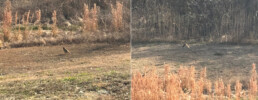
The last stretch of sidewalk leading into the neighborhood is historically the place where my trance breaks if I’ve found it. But today that quiet was lingering a bit, and just before I got to the end, I looked to my right and saw a hawk resting on the ground. Just sitting, motionless, and looking at me as I looked at him.
Three joggers had passed that spot about two minutes prior, and a man walking his boxer had just disappeared into the neighborhood a minute before. That means four humans and a dog had all passed that spot without incident. Without seeing.
Why did they not see and I did?
I stood still on the sidewalk, looking at the hawk and weighing the significance of this latest encounter. When it didn’t take flight, I pulled out my cell phone to take a picture (shown at the top of this post), I guess because I’d seen so many of them lately and here was yet another that was closer than the rest.
The hawk continued to stare at me without much fanfare, and then it suddenly took off toward the trees, soaring, gliding. I captured one more picture of its wingspan and then focused my attention on the present – on the hawk that was now perched atop one of the towering trees behind our neighborhood. I gave it one last look, turned away, and kept walking up the sidewalk.
I emerged from the greenbelt deep in thought. I’d seen at least three hawks in the past week and it was a pace above my usual. In fact, they’d kept coming and coming the last couple of months and I wanted to know what it all meant.
“Do you ever see the hawks when we’re driving?” I’d asked my husband about a week ago, after seeing another one dive toward some grass while we were speeding down the highway.
“Hawks? No. Why?” he’d said.
“I just see them all the time. I’ve seen them for years and I just saw another one. You really don’t see them?”
“Umm, nope. I don’t remember seeing any hawks.”
I’ve long thought that the hawks show up for me because they have some sort of message or are reminding me of something I’ve become disconnected with inside myself. I’ve felt this way about cardinals too, but in a different way. The cardinals showed up immediately after I lost both of my beloved kitties, and they showed up again after I sent my book into the world for preorders. I’d been crying on the patio and suddenly they were in my backyard. Lots of them. Cardinals, for me, are a sign that all is well.
Hawks, I think, are a sign of a higher calling and a greater purpose. A reminder of a connection to something bigger than myself.
I know this is true today, because as I walked home with my thoughts floating around, I came to a sudden conclusion that I so often land on after periods of non-writing that can stretch for months at a time: I’m supposed to be a writer. It was like a voice inside of my head telling me, rather than me thinking it myself.
I believe this hawk came to remind me of my calling and that I still have a higher purpose despite being beaten down so badly lately. I believe it also came to breathe fresh life into me, because after having spent the last month or two utterly burned out and devoid of anything to say, I sit here today and write this post.
Maybe it’s a good one and maybe it isn’t (it certainly hasn’t been one of my easier ones to write), but I’m at least no longer devoid of words. I at least have something to say and the desire to say it, and the ability to sit down and type something when I’ve spent the last two months in a bit of a stupor.
Yes, a hawk is just a bird. It could be a hell of a coincidence and maybe there’s nothing more to it than that. But deep inside, I know that’s not what it is. I know that this planet is held together by forces that we don’t have the capacity to understand because our scientific tools (and brains) only reach so far.
And I choose to remain open to the idea that we each have a purpose and that our guidance comes in interesting or unexpected ways. For me? It’s a hawk. It’s a soaring being who floats in and out of my life to remind me to continue to soar myself. To spread my wings and fly with the gift I’ve been given, to rise above adversity, and to achieve my highest potential while I’m on this planet.
Thank you, hawk, for continuing to show up.
———
To leave a comment or share this post, scroll down.
My first book, Halfway There: Lessons at Midlife, was released on August 18, 2020 by Warren Publishing and was re-released on February 16, 2021 by White Ocean Press. To read an excerpt, check out reviews, see the author Q&A, or find links to buy, click the Learn More button.
Second Acts
Have you ever sat around and pondered what you might like your second act to be?
Maybe you’ve never even thought about it beyond a dream because you feel constrained by the life chapter you’re in. Maybe you feel too old or too beaten. Maybe you lack the courage, or maybe you can’t even admit to that yet.
But who says you can’t rewrite your own book? Become your own hero? Change your life story?
I think often about what I want my second act to be, actually. I recently turned 39 and I’ll tell you what happened when I did. I was laying alone under my fluffy down comforter with my back propped up against the headboard, as I always do because my husband is a night owl. The clock on my phone had just hit midnight and so the date had flipped to November 10.
And as all of this happened, I decided to text my husband to tell him that I was officially a year older (I know, I know…but he goes upstairs to unwind at night and it’s just too hard to hear each other). I wrote my text and hit send, and then I just stared at the phone for a bit. Or maybe at the comforter? I don’t remember because I was really staring through whatever physical form was in my gaze.
This was all broken by the sound of his feet on the stairs and his squishy house shoes moving across the living room floor. He’d come down to wish me a happy birthday and to give me a hug, and I looked at him with one of those brave, fake smiles. And then I cried.
Not a disgusting, loud cry but more of a whimper with a quiet tear. And then it changed into a timid sob that I tried to beat down lest it turn into an all out bawl. “I don’t know why I’m crying,” I’d said to him with my face pressed into his chest, “except that I’m getting older and time is passing and I don’t want it to run out.”
Or something like that. It was late and my memories get jumbled these days when I’m up late.
I have a second act in mind that I hope I achieve before my days run out, but I’ve been reading a lot lately about how to stay present and find contentment right where I am. I’m realizing that anything I dream about for the future or am haunted by from the past are all constructs. They’re all things that I hope will happen but that don’t exist, or things that happened before but are over now. What’s real is what’s happening right at this very second, and that’s where my focus should be most of the time.
And this is sort of how I’m approaching the whole idea of having a second act. It might eventually exist and I can strive to make that happen, but I don’t need to pine for it or bemoan my present circumstances such that I can’t ever be happy in the “now” because I’m not yet where I want to be. Think of how much life you waste on negative feelings about a future that hasn’t even been written (or a past that’s long gone), while not being fully present in what is actually your life.
I think that one of the keys to a successful second act lies in thinking about it from the perspective of how you can contribute to the world. It’s not about bettering your own existence, although that should be a natural byproduct of getting onto the right path, but it’s about what you can do with your talents and vision to help make the world better. It’s the reason you came here at all.
And then once you figure that part out, you should work diligently toward that dream if you didn’t get it right the first (or fifth) time around. This requires putting a strong intention out there, working hard, and waiting to see how life unfolds. This is also where it’s important to listen to your gut as you make decisions.
These days I go through this process by first asking the universe for help in attaining my dreams. I put them out there on a regular basis, making sure my asks are for a greater good and not for my own personal gain (financial or otherwise), and then I continue making small efforts toward achieving those goals.
In between all of that I take time to get quiet. I watch. I observe. I listen for direction and stay alert for feelings in my gut. I pay attention to doors that open, or to people who show up, or to situations that occur. I look for ways to use each experience to work toward the dreams that I have.
I also try to make peace with whatever happens to be my present story, because I know I’m exactly where I’m supposed to be even when some days feel like utter catastrophe.
Life provides us with clues to our purpose and quiet guidance for our lives every single day. We just have to learn how to listen with our hearts and spirits instead of with our ears and minds. I’ve only recently learned how to do that, and my life trajectory is starting to change. That second act is finally on the horizon and I think I’ll get there soon.
Are you ready to find yours?
———
To leave a comment or share this post, scroll down.
My first book, Halfway There: Lessons at Midlife, was released on August 18, 2020 by Warren Publishing and was re-released on February 16, 2021 by White Ocean Press. To read an excerpt, check out reviews, see the author Q&A, or find links to buy, click the Learn More button.